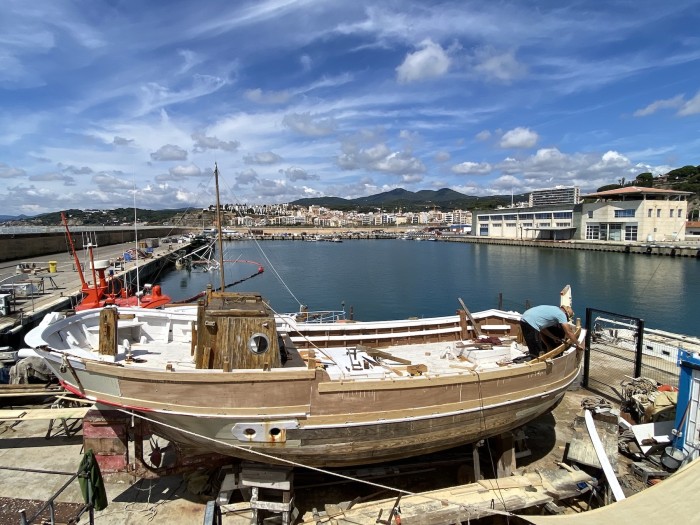
Over the past month, the Moll has been the stage for a profound transformation. Under the expert guidance of master shipwright Agustín Jordán and with the constant support of a group of volunteers, the Odina has been recovering its original structure through a four-week process filled with learning, hard work, and craftsmanship.
Since the end of the crowdfunding campaign, we hadn’t posted any updates on the Goteo blog, apart from internal messages of gratitude. It’s worth remembering that the campaign was a success, and thanks to that funding, we were able to bring Agustín back on board and restart activity at the Moll—a dedicated space for maritime trades and people of the sea. While we’ve shared the day-to-day progress on Instagram and Facebook, here is a summary of the major stages of the reconstruction process.
Week 1: Foundations and Internal Structures
The restoration began from the inside out, preparing the fit between the hull and the deck. The first critical step was the fabrication and fitting of the shelf (or clamp), the interior strake that supports the deck beams. This was precision work, requiring us to scarf the old sections with the newly reconstructed pieces. With the shelf fastened and the starboard deck supported, the foundations for the next phase were set.
Week 2: The Covering Board and the Language of Wood
During the second week, focus shifted to the starboard covering board (trancanil). Agustín not only guided our manual labor but also introduced us to the rich nautical vocabulary of the trade, defining every element with its specific term. For this vital piece, we used larch wood; symbolically, we also repurposed the last remaining pine planks used to revive the Margaret Alison, ensuring a sense of continuity between the ships of the Moll. We also began preparing the stanchions (or timber heads), the vertical pieces that support the bulwark.
Week 3: Waterproofing and the Waterway
Watertightness is fundamental in shipbuilding. To ensure this, we sealed the joints where the stanchions meet the covering board with oakum—an area that becomes inaccessible once the bulwark is completed. This served as our first caulking session, where we discovered traditional tools and techniques.
Later, we focused on the waterway (the "registro," as Agustín calls it). Despite some structural setbacks, we managed to position and cut the scuppers from stem to stern, ensuring the deck can drain correctly.
Week 4: The Upper Works and Final Details
The final week was a frantic push to finish the upper works. One of the most delicate tasks was creating tenons at the top of the stanchions, designed to fit invisibly into the underside of the cap rail. This joint provides immense structural strength to the entire bulwark.
Additionally, as a preview of the work required in the coming weeks, we had the chance to learn a Portuguese-style caulking technique from Agustín (mixing oakum and cotton) to fix a leak in the keel of the Margaret Alison, which happened to be hauled out at the same time we were working on the Odina.
Finally, the project came full circle by replacing one last plank on the bow—a task shared with vocational students (CFGM) that reminded us of the old shipwrights' saying: "the last plank is always the hardest." We concluded with a final check and re-fastening of the entire hull.
Looking to the Future
With the structure completed and inspected, the Odina is now resting while the new wood stabilizes. In a few weeks, the final caulking will be the last step before this vessel returns to the sea, carrying with it the collective effort and the wisdom of a craft that refuses to disappear.
All these works have been made possible and covered by the Goteo crowdfunding campaign. However, there is still work to be done, and we are now heading into a second phase of funding. We are currently seeking direct contributions, and we invite you to participate if you wish to help us reach the finish line.


 Channel